The Problem
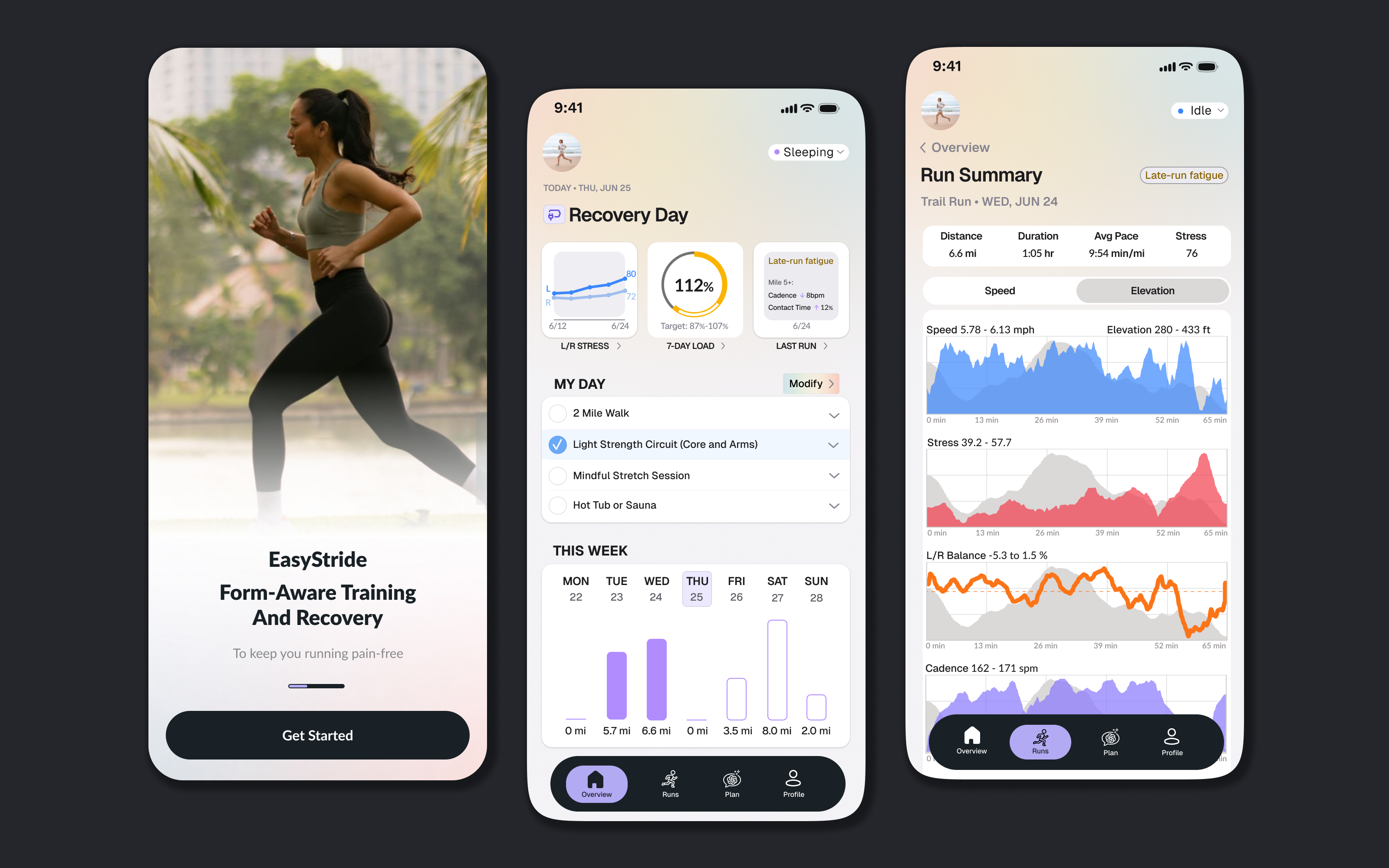
Injury-prone runners are negotiating 4 decisions daily without adequate data, translation, or guidanceEasyStride makes these decisions easier by tracking an individual's biomechanical data, comparing it to baseline, providing recommendations, and partnering with the user on training plans.
Market Gap
Why nothing on the market solves thisThe most actionable, modifiable factor in injury prevention is training load management, typically measured through Acute:Chronic Workload Ratio (ACWR) - yet no product on the market measures it from real biomechanical load. Wrist-worn devices (Garmin, COROS, Polar, Apple) derive their load metrics from heart-rate-based cardiovascular effort, a proxy for how hard the heart worked, not for how much force the skeleton absorbed. Two runs with identical wrist-based scores can produce very different tibial loading depending on terrain, fatigue, or form - so the tool most runners already own can't reliably answer "how much should I run" or "should I rest today."
Stryd, the only lower-body-worn IMU with meaningful reach among recreational runners, comes closer: its Duo sensors report real force-based bilateral load and asymmetry. But Stryd is built for performance-driven athletes chasing race times, not runners managing injury history - its load metric (Running Stress Balance) is pace/power-based and entirely disconnected from its asymmetry data, and neither is tied to a runner's pain history or translated into form or cross-training guidance.
The market splits into cardio-proxy tools for the masses and biomechanical sensors for competitive athletes - nothing fuses real load data with a runner's own injury history to guide when to run, how much, how to adjust form, and what cross-training to do.
Strategic Positioning
EasyStride is built for a runner focused primarily on staying healthy, not performance. The target user values accurate data and wants help managing biomechanical load and automatic detection of changes in their baseline form that could increase injury risk.
 Click to zoom
User Research
To ground EasyStride in real runner experience, I conducted 12 semi-structured interviews with recreational runners, all screened for a history of running injury. Participants were 8 women and 4 men - a split chosen deliberately: the interviews surfaced distinct identity profiles and motivations between the two groups, and the academic literature points to meaningful sex-based differences in running biomechanics and injury patterns. Interviews ran 30 to 60 minutes and covered running history, injury experience, PT and clinical interactions, data and wearable habits, and each runner's emotional relationship with the sport.
The Social Runner
Running is primarily a social activity for this runner - the group run is the anchor of their week, and injury means losing that as much as losing fitness. They are hesitant to invest in running gear or care because they don't consider themselves serious enough to justify it.
The On-Again-Off-Again Runner
This runner has been unable to sustain consistent training over the years, usually because of a recurring injury cycle: build up, break down, rehab, return, repeat. They manage load by tracking mileage and by feel, and have not used ACWR even when a tool they own provides it.
The Multi-Sport Athlete
Running is one part of a broader training routine, so a meaningful portion of this runner's weekly load happens outside of running and is invisible to running wearables. They are comfortable with data and have often tried form-tracking tools already, but stopped using them because the output didn't translate into a decision.
- "Not a serious runner." The strongest and most consistent theme, especially among women: 6 of 8 women - including one training for a full Ironman - noted unprompted that they hesitate to invest in their running because they don't consider themselves serious runners. The barrier is identity, not just price.
- Existing gait data isn't actionable. 2 participants had used cadence from a wrist-worn device to adjust form after injury, but 0 participants currently make any decision based on wrist-worn gait data (cadence, stride length, ground contact time). The data exists; runners don't act on it.
- PT fails recreational runners in a specific, consistent way. 11 of 12 had PT experience; 9 of 11 stopped because either (1) the exercises felt too easy to make a difference, or (2) the plan didn't feel personalized to them.
- Reliance varies widely. Some runners use heart rate, pace, or distance in real time; some look back at mileage to manage week-to-week consistency. None use ACWR to moderate training volume - even those whose tools provide it.
- 3 participants noted that some wearable data (sleep, heart rate) can be demotivating, and they sometimes avoid it.
- 10 of 12 participants said data must correlate with how they feel before they'll trust it.
- 2 participants said they need to see evidence of progress.
- Other trust pathways varied: (1) scientific evidence / journal articles showing the device works, (2) recommendations and testimonials from friends, and (3) a sanity check against their own understanding. This last one matters because many injury-management best practices don't match what runners believe or have been told (e.g., shoe choice has been shown to have little to no effect on injury rates).
| Insight | Product decision |
|---|---|
| "Not a serious runner" barrier is identity-based | Positioning around injury prevention and identity, not performance |
| Gait data exists but 0/12 act on it | Prioritize actionability over displaying metrics |
| Data must match felt experience (10/12) | Conservative alert thresholds; multi-signal confirmation; journal as two-way calibration loop |
| Data anxiety, avoidance (3/12) | Conservative alert thresholds; lead with positives |
| No one uses ACWR despite access | Automate load management through planning feature; include ACWR education in onboarding |
* Test assumption about lack of education: follow up with participants to see if they are aware of ACWR.